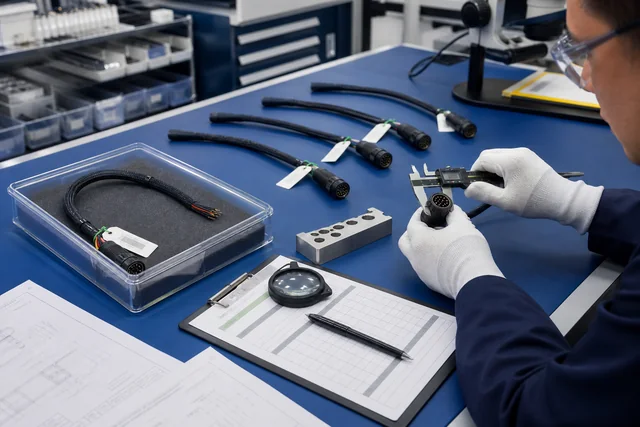
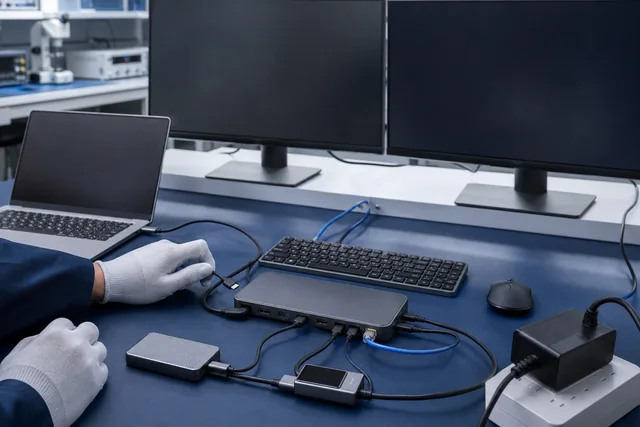
Receiving a good-looking cable sample is encouraging, but it is not the same as approving a repeatable production item. A prototype may have been hand-selected, reworked, built with temporary tooling or tested under conditions that will not exist on the production line. Its label may be correct while its internal construction remains undocumented. Even a sample that works perfectly in one device can leave unanswered questions about another host, another operating condition or the next material lot.
The buyer therefore needs an approval chain, not a single yes-or-no email. That chain should connect the controlled requirement to the exact sample, the exact evidence, the build conditions, any deviations, the pilot process and the final release authority. It should also remain usable months later, when someone proposes a new terminal, cable compound, fixture, production line or packaging method.
The following stage-gate method begins after commercial and technical requirements have been agreed well enough to build controlled samples. If the drawing, pinout, application constraints or evidence scope is still open, first return to the custom cable RFQ guide. Do not use sample approval to hide unresolved design decisions.
First separate the five objects people casually call “the sample”
Misunderstandings often begin because every pre-production unit is described as a sample. The buyer should label the build purpose before reviewing the result.
1. Engineering sample
An engineering sample explores feasibility or closes design questions. It may use temporary processes, alternate materials or manual operations. It can be valuable for checking connector direction, routing, basic function or packaging space, but it should not be treated as evidence that the final production configuration is repeatable.
The record should state what is provisional. If a temporary cable, connector, mold, label or assembly method was used, mark that difference visibly. Approval should say “engineering direction accepted” rather than “production approved.”
2. Approval sample
An approval sample is expected to represent a defined revision. Its materials, construction, dimensions, marking and test route should match the proposed production baseline except for explicitly documented exceptions. The buyer evaluates it against agreed acceptance criteria and records the disposition.
An approval sample can become part of the golden-sample package, but only after deviations are closed or formally authorized.
3. First article
A first article is a unit or set of units selected for documented verification against the controlled product characteristics. The accompanying first article inspection report should show what requirement was checked, how it was checked, the actual result or traceable pass/fail evidence, and who reviewed it.
FAI is not automatically a universal certification. SAE AS9102, for example, establishes documentation requirements for aerospace first article inspection. A buyer outside that scope should not casually advertise “AS9102 FAI” when the project merely uses a custom inspection sheet. Conversely, when a contract invokes AS9102 or another formal scheme, a generic checklist is not an adequate substitute.
4. Golden sample
A golden sample is a retained, approved physical reference. It is most useful for attributes that can be compared directly: overall appearance, label placement, color, overmold shape, connector orientation, branch layout or workmanship examples. Both buyer and supplier may retain identified units when that arrangement is practical.
The word golden does not make the unit complete or permanent. A retained cable can fade, oxidize, become contaminated, be bent outside its intended radius, lose a label or be separated from its paperwork. Physical comparison can also be subjective. The retained unit therefore needs an identifier, seal or storage control, approval date, revision, photographs and a linked digital record.
5. Pilot lot
A pilot lot tests the planned production system, not merely the design. It should use the intended production materials, released work instructions, tooling, fixtures, inspection steps, traceability and packaging as far as the project requires. Its quantity should be large enough to expose repeatability, handling and flow issues, but the correct size is project-specific.
A pilot lot may reveal variation that one carefully prepared approval unit cannot show: cut-length drift, crimp variation, overmold flash, label position movement, test-fixture false failures, mixed components, packaging damage or incomplete records.
The eight-gate approval route
The route below gives each approval a defined question. A project may combine gates for a simple, low-risk cable or add validation gates for a high-consequence application, but it should not silently skip the underlying decisions.
Gate 1: Freeze the approval baseline
Before the controlled build starts, issue an approval-cover record that identifies:
- buyer part number and supplier part number, if both exist;
- drawing or specification number and revision;
- controlled pinout or wiring table;
- approved material list or construction record at the necessary level;
- applicable label, packaging and traceability requirements;
- acceptance standards or project-specific criteria;
- required inspections and tests;
- required specimens, including any separate units for destructive testing;
- known deviations, open points and approval authority;
- target sample-build and evidence dates.
The baseline should distinguish a requirement from a measurement method. For example, “finished length 1,000 mm with the drawing tolerance” is a product requirement. The measuring tool, fixture, preconditioning and recording precision belong to the inspection method. Both matter, but keeping them separate makes later method improvements easier to manage.
Do not approve against an email attachment whose revision cannot be proven. A filename such as final-v7-new is not a dependable configuration identifier. Use a controlled number, revision, date and approver, and withdraw superseded files from the active approval package.
Gate 2: Declare how the sample was built
The sample-build record should answer a question that photographs cannot: “How representative is this unit of the proposed production route?”
Record the identity or status of critical materials, the manufacturing location, tooling or temporary tooling status, relevant work-instruction revision, build date, lot or traveler identifier and any rework. If exact lot numbers or confidential process details are not contractually required, the parties can agree on an appropriate traceability level. The essential point is to avoid implying production equivalence when the build was exploratory.
Classify every departure before testing:
- Planned prototype exception: known before the build and accepted only for learning.
- Temporary process difference: the intended design was used, but tooling or assembly conditions were not production-representative.
- Unexpected nonconformance: a requirement was missed and needs disposition.
- Unverified characteristic: no acceptable evidence is yet available.
None of these states should be converted into “pass” through silence.
Gate 3: Build the characteristic-level inspection record
A useful first-article record follows the specification characteristic by characteristic. It does not merely say “drawing checked.” For each applicable line, include the requirement reference, nominal value or condition, tolerance or acceptance limit, inspection or test method, instrument or fixture identification when required, sample quantity, actual result, pass/fail disposition and evidence reference.
Group the checks so reviewers can see coverage:
Identity and configuration
Confirm part numbers, revisions, connector identities, gender, keying, orientation, contact population, cable type, color, label content and packaging version. Where a manufacturer part number is not fixed, confirm the approved technical description and approved-alternate status rather than accepting an undocumented substitution.
Dimensions and mechanical fit
Check finished length using the drawing's defined reference points, branch dimensions, breakout position, strip dimensions where applicable, outer diameter, overmold envelope, connector orientation and critical clearance. A mating check can support fit review, but it does not replace controlled dimensional results when dimensions are specified.
Electrical and functional characteristics
Select checks from the actual design and risk: continuity, pin-to-pin mapping, shorts, conductor resistance, insulation resistance, dielectric withstand, shield continuity, signal integrity, power delivery or system function. Do not add impressive-sounding tests without a product requirement, defined method and acceptance limit.
The IEC 60512 series illustrates an important principle: connector test methods are used with detail product specifications that define the relevant test, severity and permissible performance limits. A method name alone does not define what a particular cable must pass.
Materials and construction
Confirm the evidence needed for conductor, insulation, jacket, shield, contacts, shells, fasteners, overmold or other controlled materials. The level may range from part-number verification to supplier declarations or test evidence, depending on risk and contract. Do not assume that visual similarity proves identical material or plating.
Workmanship and appearance
Apply the agreed criteria to termination, crimp, solder, strain relief, shielding, overmold, marking and finished assembly. IPC describes IPC/WHMA-A-620 as an industry-consensus standard for cable and wire harness assembly requirements and acceptance, but IPC also notes that A-620 does not itself specify the frequency of in-process or product inspection. The project must still define the applicable revision, class or scope, inspection plan and any customer-specific criteria.
Packaging and traceability
Confirm labels, quantities, protective caps, bend and coil method, bag or carton markings, lot identity, barcode readability and any preservation needs. A technically conforming cable can still fail the buyer's operation if packaging damages the product or breaks traceability.
Gate 4: Decide what each piece of evidence proves
Not every characteristic requires the same evidence type. The approval plan should map evidence to the decision:
| Evidence | Appropriate use | Important limitation |
|---|---|---|
| Visual inspection | Appearance, orientation, marking and visible workmanship | Cannot prove internal construction or electrical performance |
| Dimensional record | Controlled measurements against drawing limits | Depends on defined datums, method and calibrated equipment where required |
| Electrical test record | Defined continuity, resistance, insulation or functional checks | A pass is meaningful only with the correct limits, setup and configuration |
| Material document | Identity or declared composition of a specified material | Must match the actual part, supplier, revision and lot scope required |
| Destructive analysis | Internal termination, cross-section or construction evidence when specified | Consumes or alters the specimen; use separately identified units |
| System trial | Interaction with named host and sink equipment | Does not prove universal interoperability or every environmental condition |
| First-article report | Characteristic-level conformance record for the inspected configuration | Does not by itself prove long-term process capability |
| Pilot-lot data | Repeatability and control under a representative build | Does not eliminate ongoing lot inspection or change control |
For certificates, declarations and reports, use the test and compliance documents guide to verify applicability to the exact product, material, company, destination and time period. A generic file in a sales package should not be silently attached to the approval record as model-level proof.
Gate 5: Close deviations without changing the requirement by accident
Samples rarely produce only perfect passes or obvious failures. The difficult cases are usable units that miss a documented requirement. A controlled process gives each discrepancy a recorded disposition:
- Reject and rebuild: the sample cannot support the intended decision.
- Rework and reinspect: allowed only when the rework is authorized, recorded and representative of an acceptable production route.
- Temporary deviation: the buyer accepts the specific departure for a defined quantity, lot or period.
- Specification revision: engineering intentionally changes the requirement through its normal approval process.
- Use as engineering evidence only: the unit supports learning but not production release.
A deviation is not a quiet edit to the inspection sheet. It should identify the affected characteristic, actual condition, reason, risk review, compensating action, authorized scope, expiration and required follow-up. An approval email saying “looks acceptable” should not override a controlled drawing unless the buyer's own configuration process formally makes that change.
Review functional passes with particular care. If a cable works despite a dimensional or material deviation, the result may justify engineering analysis, but it does not prove the original requirement was unnecessary. The reviewer should either require conformance or revise the requirement through the authorized route.
Gate 6: Create a golden-sample package, not just a tagged cable
After the approval sample and deviations are resolved, assemble the retained reference package. A practical package can include:
- the identified physical sample or matched buyer-and-supplier samples;
- approved drawing, pinout and material/construction revision;
- first-article or sample-inspection record;
- approved deviation records and their expiration;
- dated photographs showing overall construction and critical details;
- test reports linked to the exact sample identity;
- label and packaging artwork;
- build route and traceability reference at the agreed level;
- storage, handling, retention and disposal rules;
- signatures or electronic approvals with roles and dates.
State the precedence order. Usually the controlled specification should govern measurable requirements, while the golden sample assists interpretation of visual attributes. If the physical reference and current drawing conflict, stop and resolve the discrepancy; do not let the oldest object win by habit.
Define when the retained unit must be replaced or revalidated. Triggers may include damage, aging, label deterioration, a released revision, approved material change or evidence that the retained unit no longer represents production. Record the relationship between the old and new reference so the change history remains auditable.
Gate 7: Use the pilot run to approve repeatability
The pilot-run plan should identify what must now be production-representative. Typical considerations include released materials, normal operators, intended tooling, fixtures, work instructions, line layout, test software, inspection points, traceability, packaging and planned production rate. If an element remains temporary, state the limitation and decide whether another run is required.
Review more than the finished units:
- Were all planned materials available and correctly identified?
- Did operators understand the released instructions?
- Did fixtures prevent or detect wrong orientation and miswiring?
- Did the test process produce stable, attributable records?
- Were rework and scrap visible rather than hidden?
- Did dimensions or electrical results show drift across the run?
- Did packaging preserve the approved condition through handling?
- Were nonconformances contained and linked to corrective action?
- Can the lot be traced back to the build record and forward to shipment?
For ongoing lot acceptance, a project may use an agreed statistical sampling plan. ISO 2859-1:2026 defines AQL-indexed sampling schemes for lot-by-lot inspection by attributes. The buyer should not treat AQL as permission to ship a stated percentage of defects, and sampling should not replace validation or any required 100 percent check for a critical characteristic. Select the scheme, inspection level, switching rules and defect classifications through the applicable quality agreement and risk review.
Pilot approval should explain whether the run demonstrated the intended rate and process or only a limited build. A low-volume manual assembly may have a different release basis from an automated high-volume line. The decision should reflect the actual production route, not a generic definition of “pilot.”
Gate 8: Issue a production-release decision
Production release should be an identifiable record with one of several clear outcomes:
- Released: all required gates are complete for the identified revision and route.
- Released with conditions: limited production may proceed under named controls, quantities, dates or open-action deadlines.
- Pilot only: more evidence is required before normal production.
- Not released: identified gaps prevent production authorization.
The release record should name the approved part and revision, manufacturing route or site scope as required, effective date, evidence package, outstanding conditions, approvers and next review trigger. It should also state whether tooling, packaging and test setup are included in the release.
Avoid relying on purchase-order placement as an implied technical approval. Commercial authorization and product/process release can occur in the same workflow, but each decision should be visible. That separation protects both buyer and supplier when schedules are compressed.
Why a golden sample cannot carry change control by itself
Once production begins, a material risk is not an obvious defect but an unreviewed change. A component can become unavailable, a sub-supplier can change, tooling can wear, a process can move, software can be updated or packaging can be redesigned. The resulting cable may still resemble the retained sample while its risk profile has changed.
Define a supplier-change-notification route before release. The change request should describe the current and proposed states, reason, affected parts and orders, implementation timing, inventory disposition, risk analysis and proposed validation. The buyer then decides whether the change requires document update, sample submission, partial FAI, full FAI, pilot evidence, compliance-document review or no additional test.
Common reapproval triggers include:
- drawing, pinout, tolerance or performance-limit revision;
- connector, terminal, contact, wire, jacket, shield, adhesive or overmold material change;
- new manufacturer or sub-supplier for a controlled item;
- tooling replacement, major repair or cavity change;
- production-line, facility or country-of-origin change where relevant;
- termination, crimp, solder, molding, curing or test-process change;
- test fixture, test software or acceptance-limit change;
- long production interruption when process validity may have lapsed;
- corrective action after a significant escape or recurring defect;
- packaging change that can affect product condition or traceability;
- regulatory or customer requirement change.
Not every change requires a complete restart. Use impact analysis to define the affected characteristics and the minimum sufficient revalidation. The key is that authorized reviewers make that decision before unapproved product enters normal supply.
ISO's published guidance around ISO 9001:2015 highlights control of changes and retaining information about review, authorization and necessary actions. That principle is useful whether or not a buyer invokes ISO 9001 contractually: a change record needs an owner, an assessment, a decision and evidence. This article does not claim any organization is certified to ISO 9001.
Ten approval failures buyers should prevent
1. The show sample
A specially selected, polished or repeatedly reworked unit is presented without disclosing that it does not represent normal production. Prevent this by recording build conditions and rework.
2. Revision ambiguity
The sample, drawing and inspection report carry different or missing revisions. Prevent this with a single approval-cover record and configuration check before inspection.
3. Pass/fail without actual results
Every row says “pass,” but no measurable result, method or evidence link exists. Record actual values where they are meaningful and preserve traceable evidence for binary tests.
4. Functional testing in only one friendly system
The sample works on one bench setup and is described as universally compatible. Define the named equipment, operating condition and limits of the trial.
5. Destructive tests performed on the golden sample
The retained reference is cut, cross-sectioned or stressed and can no longer serve its intended purpose. Allocate separate, identified specimens.
6. Temporary substitutions become permanent
A prototype alternate is accepted for schedule reasons and later enters production without review. Mark temporary items in the baseline and set an expiration or closure action.
7. Golden sample outranks the drawing
Operators copy a physical unit even after the specification changes. Define document precedence and replace or relabel retained references after revision.
8. FAI is mistaken for process capability
One inspected unit conforms, so repeatability is assumed. Use a representative pilot build and ongoing controls appropriate to the risk.
9. Pilot lots hide rework
The final units pass, but the process required excessive adjustment, sorting or repair. Review yield, rework, scrap and failure patterns as part of the release decision.
10. Change control begins after the first problem
The parties discuss notification only after an unapproved substitution is discovered. Define triggers, notice content and reapproval authority before production release.
A compact approval dossier for handoff
At the end of NPI, a person who did not attend the sample meetings should be able to understand what was approved. A compact dossier should answer:
- What exact product and revision are released?
- Which requirements and controlled documents apply?
- Which sample or lot was inspected?
- How representative was its build route?
- What were the actual inspection and test results?
- Which deviations remain valid, and when do they expire?
- What physical and digital golden references are retained?
- What did the pilot run demonstrate?
- Who approved normal production, and under what conditions?
- Which future changes require notification or reapproval?
This dossier is more useful than a large, unindexed folder. Use consistent identifiers and links so a reviewer can move from a characteristic to its evidence without guessing.
Where representative CoreCavo product families may fit
If an existing HDMI, USB, DisplayPort, DVI/VGA or active optical cable family appears relevant, treat the catalog entry only as a starting point for confirmation. A page image or model description does not establish that the item matches the buyer's pinout, materials, dimensions, host equipment, environment, evidence requirements or approval plan.
The custom cable configurator can help organize known requirements, and the sample request route can be used to ask what sample scope may be feasible. Neither route is itself an approval record. Availability, construction, tests, evidence, timing and representativeness must be confirmed for the actual project.
Send an approval-ready project packet
If the RFQ stage is complete and you need to discuss a sample-to-production route, use the request a quote form to submit:
- controlled part number, drawing and revision;
- sample type requested and the decision it must support;
- required characteristic list and acceptance limits;
- required inspection, functional or document evidence;
- destructive-test specimen needs;
- target pilot quantity and production assumptions;
- golden-sample retention expectations;
- required change-notification and reapproval triggers;
- open points that still need confirmation.
Ask for a written response that separates confirmed support, proposed methods, exceptions and unresolved items. A request is not an assurance that a particular process, test, standard, volume or schedule is available. Those items require project-specific technical and commercial confirmation before approval.
Sources, methodology and responsibility
this guide synthesizes a buyer-side NPI and release-control workflow. Standards are cited to define boundaries and examples, not to reproduce proprietary criteria or imply certification. The project must purchase, access and apply any required standard through authorized channels and confirm the current revision required by its contract.
- IPC — Meet Your Standards. IPC identifies IPC/WHMA-A-620 as the industry-consensus requirements and acceptance standard for cable and wire harness assemblies and notes limits including that the standard does not itself specify inspection frequency.
- IPC — Document Revision Table. Official revision-status reference; confirm the contractually required revision and applicable addendum rather than assuming “latest” automatically governs.
- SAE International — AS9102 Aerospace First Article Inspection Requirement. Official scope and revision record for the aerospace FAI documentation standard.
- AIAG — Production Part Approval Process. Official overview explaining PPAP's focus on showing that design-record and specification requirements can be met consistently during an actual production run at production rates.
- ISO — ISO 2859-1:2026, Sampling procedures for inspection by attributes. Official overview of AQL-indexed lot-by-lot acceptance-sampling schemes and switching rules.
- ISO — Implementation Guidance for ISO 9001:2015. Official implementation guidance; use the purchased standard and applicable contractual requirements for formal implementation.
- IEC — IEC 60512-1:2018, Connectors for electrical and electronic equipment — Tests and measurements — Generic specification. Official scope explaining that detailed connector test methods work with product specifications that prescribe the applicable tests, severity and performance limits.